
Answer first: what a brand messaging framework does
- If your audience cannot quickly understand what you do, who you help, and why you are different, every channel becomes harder.
- Unclear messaging can make social posts underperform, increase ad costs, and cause website visitors to leave without acting.
- A strong brand messaging framework gives your business clearer positioning, sharper communication, and more consistent marketing.
A brand messaging framework gives your business one clear system for communicating value.
It connects your messaging strategy, brand positioning, value proposition framework, website messaging, and brand voice guidelines into one usable structure.
The result is simple: your team speaks with one voice, your audience understands the offer faster, and your marketing performs better.
Why messaging matters for growth
Messaging is not just branding polish. It is a growth lever.
When your positioning is clear, people spend less time decoding your offer and more time evaluating it.
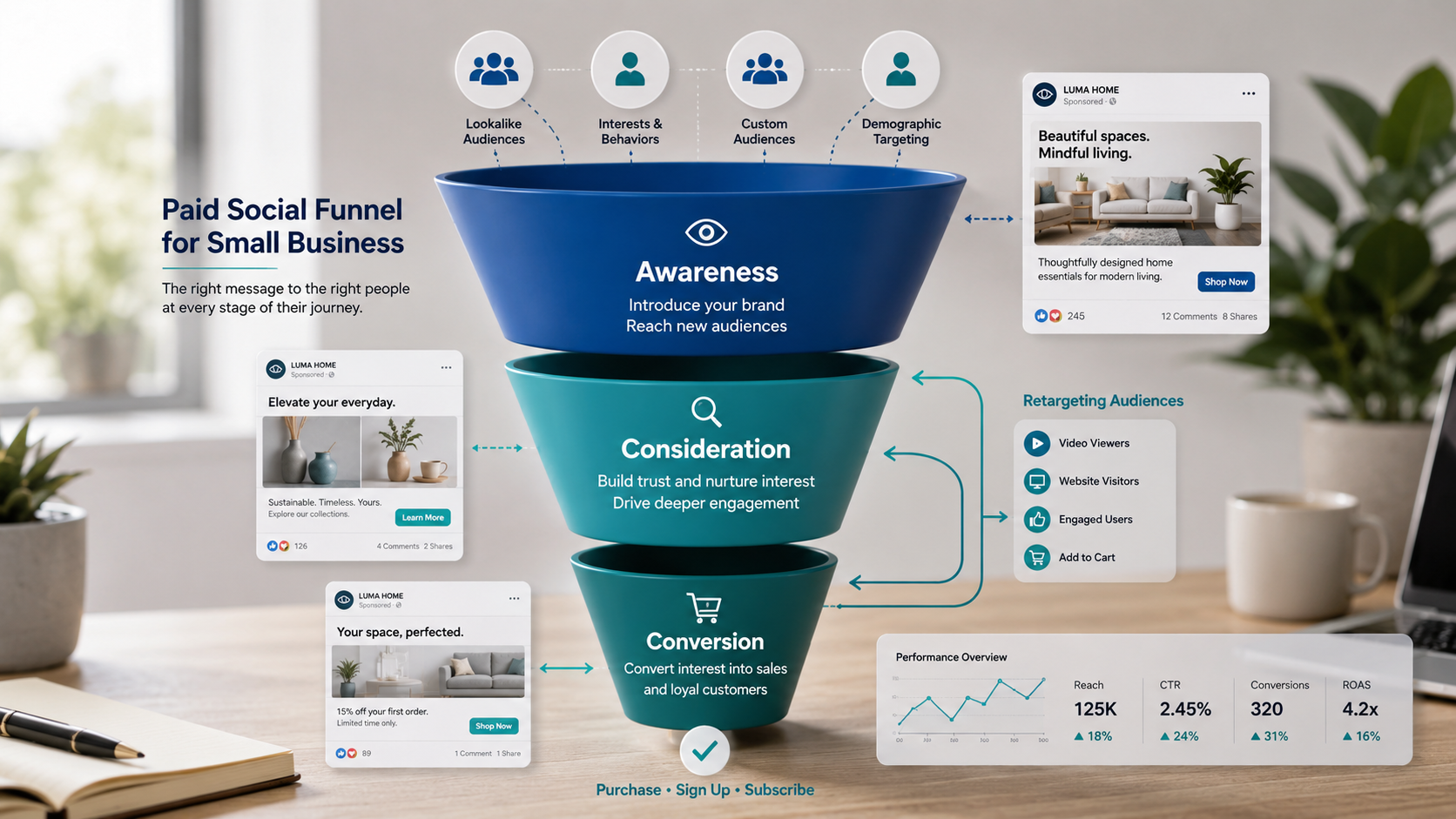
That matters across the full funnel. Clear website messaging improves conversion. Strong social messaging improves engagement. Precise ad copy improves click quality. Better SEO content attracts the right audience.
This is why informational and strategic content around messaging should be treated as part of your revenue system, not a creative exercise.
The core elements of a strong framework
A useful brand messaging framework does not need to be complicated. It needs to be specific.
Start with these five parts:
- Audience — Who are you speaking to?
- Problem — What pain point or friction are they trying to solve?
- Outcome — What result do they want?
- Differentiation — Why should they choose you over alternatives?
- Proof — What evidence supports your claim?
These elements create the base of your positioning statement and make your messaging easier to use across channels.
Audience pain points and outcomes
Good messaging starts with the customer, not the company.
Write down the problems your buyers actually feel. Not broad industry issues. Real friction.
For example:
- They are getting traffic but not leads.
- Their website sounds generic.
- Their social content gets views but no enquiries.
- Their team says different things in different places.
Then define the outcome they want.
More qualified leads
Messaging should help the right people understand the offer faster.
Better conversion rates
Clearer value makes it easier for visitors to take action.
Clearer brand recall
Simple messaging helps people remember what you do and why it matters.
Faster buying decisions
When the message is clear, comparison and decision-making become easier.
This is where your value proposition framework becomes useful. It should connect the pain point to the result in plain language.
Differentiation and positioning
Brand positioning is where many companies drift into vague claims.
“High quality.” “Tailored solutions.” “We care about results.”
Those phrases do not position you. They blend in.
A stronger positioning statement answers three questions:
- What category are you in?
- Who is it for?
- Why are you the better choice?
Keep it practical. The goal is not clever wording. The goal is clear market fit.
If your business serves startups, local businesses, or growing brands, your positioning should reflect the stage they are in and the outcomes they need now. That might mean faster lead generation, stronger visibility, or a cleaner digital presence.
Translating strategy into website copy
Website messaging is where strategy becomes visible.
Your homepage should not try to say everything. It should say the right thing quickly.
Focus on:
- A clear headline that states the core offer
- A subheading that explains the result
- A short proof point or differentiator
- Service sections that use simple language
- Calls to action that match intent
Keep the copy direct. Avoid internal jargon. Use the words customers would use when searching, comparing, or asking for help.
If the page is about digital branding, the message should make it obvious how the service improves recognition, trust, and conversion.
Applying messaging across social, SEO, and ads
Your messaging should stay consistent across channels, even if the format changes. Social media needs shorter, sharper hooks. SEO needs clearer topic focus and search-aligned language. Paid ads need immediate relevance. Web pages need more context and proof.
The format can change, but the core message should stay the same. That is how you connect messaging clarity to better performance across social and beyond.
If your brand says one thing on LinkedIn, another on your homepage, and something else in ads, trust drops. Consistency reduces friction and improves recall.
A simple leadership worksheet
Use this internal worksheet before you publish anything:
- Who are we speaking to?
- What problem are they trying to solve?
- What outcome do they want?
- What makes us different?
- What proof can we show?
- What tone should we use?
- What should stay consistent across channels?
If a team cannot answer these questions clearly, the messaging is not ready.
A strong brand messaging framework is not about sounding impressive. It is about being understood fast. When your messaging strategy is clear, your brand positioning improves, your website messaging converts better, and your content becomes easier to scale. That clarity compounds across social, SEO, paid ads, and sales.
FAQ
What is a brand messaging framework?
A brand messaging framework is a structured system for defining what your company says, who it speaks to, and how it explains value consistently.
What is the difference between brand positioning and a positioning statement?
Brand positioning is the broader market perception you want to own. A positioning statement is the concise expression of that position in words.
How do brand voice guidelines help?
Brand voice guidelines keep tone, language, and style consistent so every channel sounds like the same business.
Why does website messaging matter?
Website messaging matters because it shapes first impressions, reduces confusion, and helps visitors decide whether to take action.
Can messaging improve ad performance?
Yes. Clear messaging improves relevance, which can lead to better click quality, stronger conversion rates, and less wasted spend.