Small businesses often run Meta ads the same way they post on social: one idea, one boost, one hope.
That approach wastes budget. A better Meta Ads funnel strategy turns paid social into a system. It matches the message to the stage, moves people from awareness to action, and gives every campaign a job.
If you want better results from Facebook ads or Instagram ads, start with the funnel.
What a Meta Ads funnel looks like
- A Meta Ads funnel strategy helps small businesses match the right message to the right stage of intent.
- Top-of-funnel campaigns should focus on building attention instead of asking for an immediate sale.
- Middle-funnel ads should educate, qualify, and move warm audiences closer to action.
- Bottom-funnel retargeting is where many small business paid social campaigns win or lose efficiency.
- Creative, targeting, and budget should change based on the funnel stage.
- A simple Facebook ads funnel or Instagram ads funnel is more effective than treating every ad like a standalone promotion.
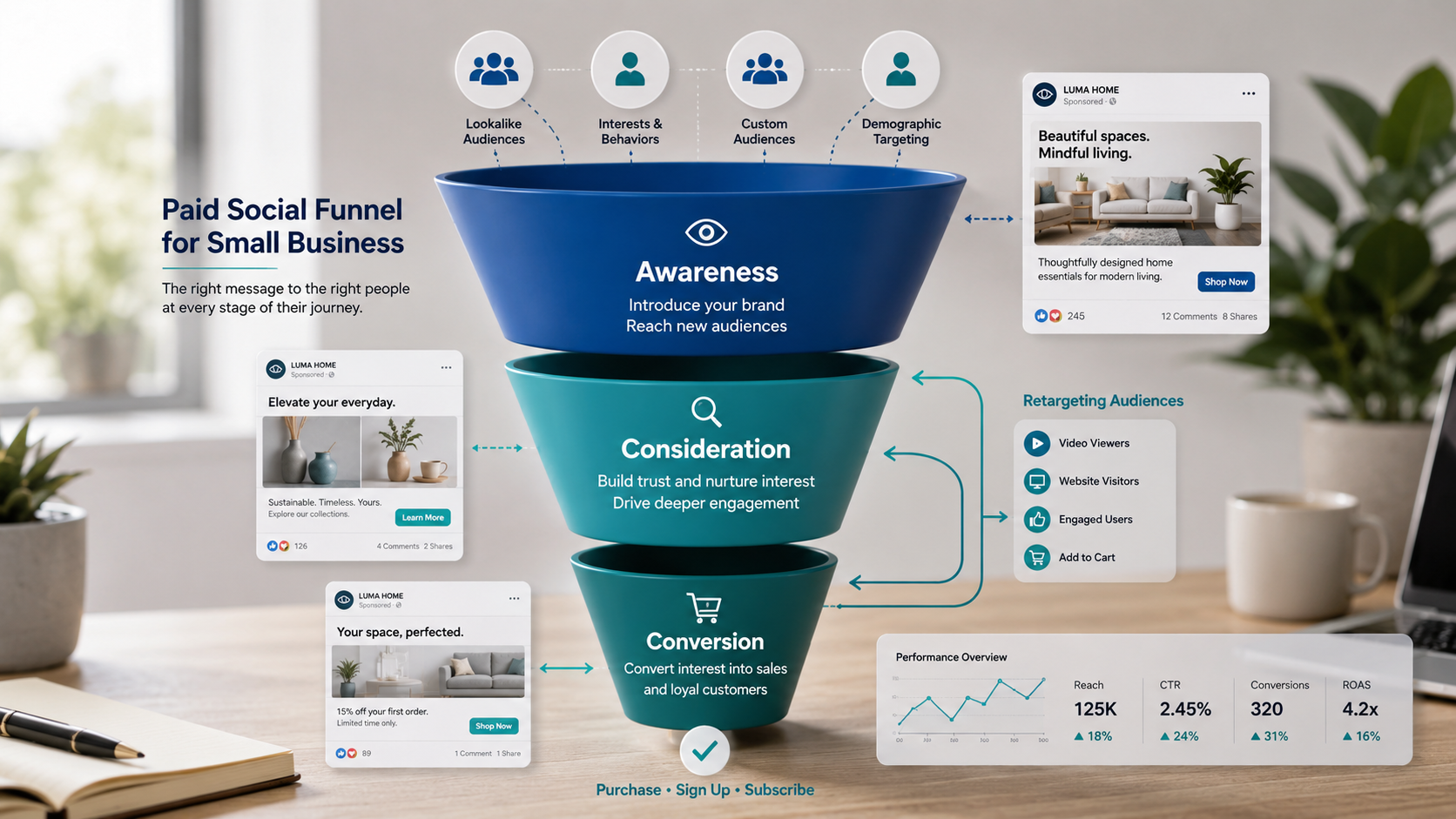
A Meta Ads funnel strategy is a structured way to run campaigns based on buyer intent.
Instead of treating every ad like a direct sales push, you guide people through stages:
- Top of funnel: introduce the brand and build attention
- Middle of funnel: educate and build trust
- Bottom of funnel: convert warm audiences into leads or sales
This matters because most people are not ready to buy the first time they see you.
A good Facebook ads funnel respects that reality.
Top-of-funnel: build attention first
Top-of-funnel campaigns are for cold audiences. These people may not know your brand, your offer, or even that they have a problem yet.
The goal here is simple: get noticed.
Best creative types:
- Short video hooks
- Problem-aware carousel ads
- Founder-led or brand-led storytelling
- Educational stat-led creatives
Best targeting options:
- Broad interest groups
- Lookalike audiences
- Light demographic filters
- Advantage+ style broad delivery, where appropriate
Do not ask for the hard conversion too early. A cold audience usually needs context before it needs a quote form.
For small business paid social, this stage is about efficient discovery.
Middle-funnel: educate and qualify
Middle-funnel ads are for people who have already engaged with your brand.
They may have watched a video, visited your website, clicked an ad, or interacted with your Instagram profile.
This is where your Meta advertising strategy should shift from attention to proof.
Best creative types:
- Case study ads
- Testimonial ads
- Comparison ads
- Lead magnet ads
- Problem-solution explainers
Best audience segments:
- Website visitors
- Video viewers
- Engaged social users
- Lead form openers who did not submit
This stage is where trust starts to compound.
If your top-of-funnel ad gets attention, the middle-funnel ad should answer the next obvious question: why should I believe you?
Bottom-funnel: convert warm audiences
Bottom-funnel campaigns are where the retargeting funnel does its best work.
These ads are for people who are already warm and closer to action.
They may have added a product to cart, visited a service page, opened a form, or returned to your site more than once.
Best creative types:
- Direct offer ads
- Limited-time incentive ads
- Strong CTA ads
- FAQ or objection-handling ads
- Lead generation ads with a clear next step
Best audience segments:
- High-intent website visitors
- Past engagers
- Lead form drop-offs
- Cart abandoners, if relevant
At this stage, clarity wins.
Say what the offer is. Say who it is for. Say what happens next.

How to target by intent level
A strong Instagram ads funnel is not built on random interests alone.
It is built on intent.
Think in three levels:
Cold intent
People who do not know you yet. Keep the message broad and relevant.
Warm intent
People who have engaged but not converted. Use proof, education, and reminders.
Hot intent
People who are ready to act. Remove friction and make the next step obvious.
This structure helps you avoid wasting spend on audiences that are too cold for a sales message.
It also stops you from under-serving warm users who need one more reason to convert.
Retargeting sequences that convert
A retargeting funnel works best when the message changes over time.
Do not show the same ad to the same audience for weeks.
Use a simple sequence:
- First retargeting ad: reinforce the problem and your solution
- Second retargeting ad: show proof, results, or social validation
- Third retargeting ad: present the offer and clear CTA
This sequence keeps the campaign moving.
It also helps small businesses avoid the common mistake of retargeting too aggressively with the same creative.
If someone has already seen your brand three times, they do not need more noise. They need a reason to act.
Budget priorities for smaller accounts
Small businesses do not need a large budget to run a smart Meta Ads funnel strategy.
They need discipline.
A practical starting split:
- 50% top and middle funnel combined for discovery and nurturing
- 30% bottom-funnel retargeting for conversion efficiency
- 20% testing for new creative, audiences, or offers
If your traffic volume is low, retargeting may be limited.
If your market is highly competitive, testing may need more room.
The point is not to copy a fixed formula. The point is to assign each euro a job.
That is how small business paid social becomes measurable instead of reactive.
Common funnel mistakes to avoid
Most Meta ad accounts underperform for the same reasons.
Avoid these mistakes:
- Running one ad to everyone
- Asking cold audiences to buy immediately
- Using the same creative across every stage
- Ignoring retargeting
- Sending paid traffic to weak landing pages
- Scaling before the funnel is proven
The biggest mistake is treating Meta ads as a series of boosts instead of a system.
When that happens, spend rises faster than results.
Takeaway
A strong Meta Ads funnel strategy helps small businesses spend with purpose.
Build attention first. Educate second. Convert last.
When your Facebook ads funnel or Instagram ads funnel is structured by intent, you get better leads, stronger retargeting, and cleaner budget decisions.
FAQ
What is a Meta Ads funnel strategy?
It is a campaign structure that aligns creative, targeting, and offers to each stage of the buyer journey.
Do small businesses need separate campaigns for every funnel stage?
Not always, but they should separate audiences and messages so each stage has a clear role.
What is the best use of retargeting?
Retargeting works best for warm users who already know the brand and need proof, reminders, or a stronger offer.
How do lead generation ads fit into the funnel?
They usually belong in the middle or bottom of the funnel, where the audience already has some trust or intent.
What is the biggest mistake in small business paid social?
Trying to sell too early to cold audiences without enough education or proof.